
Key takeaways
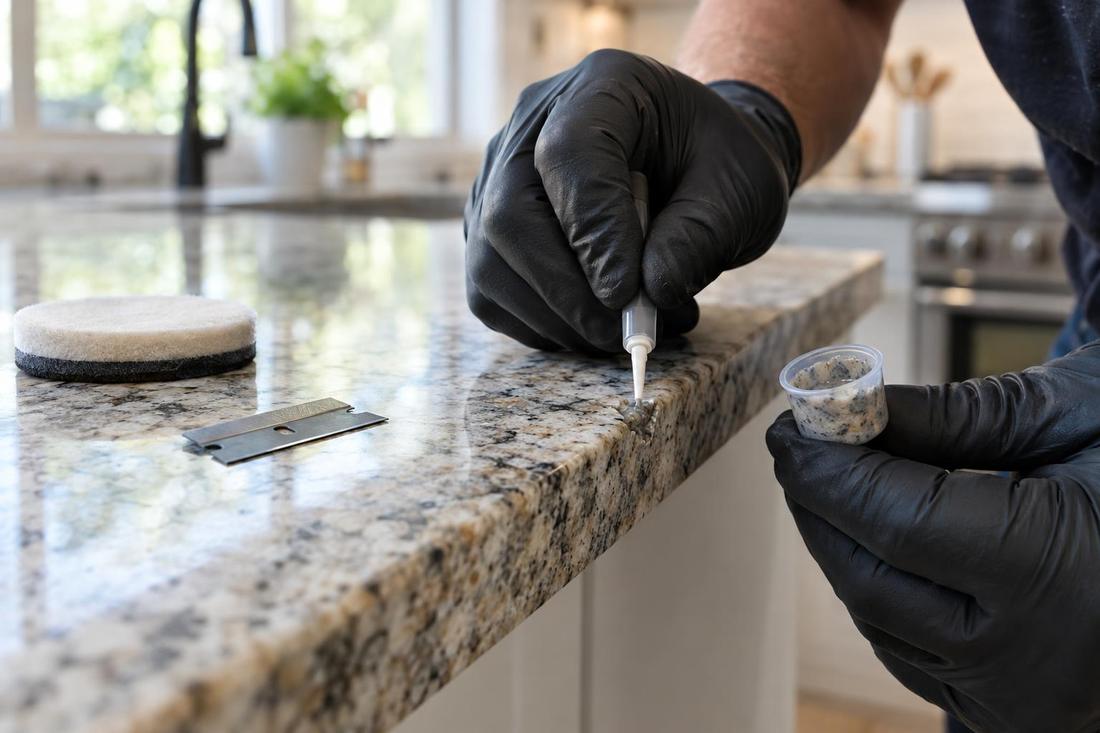
- Most chips on edges and corners can be filled and polished.
- Cracks need a cause check: look for unsupported spans, stress at cutouts or uneven cabinets.
- Stains often respond to poultices, and etching can be honed out.
- When damage is large or structural, replacement can be the better choice.
Chips and dings
Small chips on edges and corners are the most common damage, and they are usually repaired with color-matched resin that is cured and polished flush. The finished repair is hard to see on busy patterns, though it is not as strong as an undamaged edge.
Save any chip fragment, which can sometimes be reglued.
Cracks and seams
A crack often starts at the corner of a cutout or in an unsupported span. A repair starts by finding the cause, then gluing and filling the crack and, if needed, adding support underneath. Open seams are reglued and leveled.
A crack that keeps growing may mean the support or cabinet needs attention.
Stains and etching
Stains from oil, organic matter or rust can often be drawn out with the right poultice, and deep cleaning removes buildup. Etched marble can be honed and polished back to an even finish. Different stains need different treatments, so identify the stain first.
Avoid harsh chemicals that can make things worse.
Repair or replace
A repair makes sense when the damage is small and the rest of the top is sound. Replacement is better when damage is large, the stone has failed in several places or you are changing the kitchen anyway. We give an honest view after we see the top.
Photos of the damage help us advise before a visit.
Official sources and further reading
These are independent organizations. Links open in a new tab.
Quick answers
Will a repaired chip hold up?
In normal use, yes. A well-made repair holds well, though a hard impact in the same spot can damage it again.
Can quartz be repaired?
Chips can often be filled, but color matching is harder on some patterns. We assess each case.